

Ibn Umar, may Allah be pleased with him, relates that the Holy Prophet, peace and blessings of Allah be upon him, said: "Islam is based on five articles:
Shahadah
Salat
Saum
Zakat
Hajj
Shahadah (Declaration of Faith)
A Muslim expresses his/her faith (Iman) in the following words:
Ash-hadu anla ilaha illal-Lahu Wahdahu la Sharika Lahu wa-ash-hadu anna Muhammadan abduhu wa rasuluhu
The English translation of the Shahadah is as follows:
I bear witness that there is none worthy of worship except Allah, the One, without any partner. And I bear witness that Muhammad is His servant and His Messenger.
The declaration of faith consists of two distinct parts, i.e., the absolute belief in the Unity of Allah (God) and the belief in the Holy Prophet Muhammad as a mortal human being and the Messenger of Allah.
Islam's fundamental belief is the Unity of God. All other beliefs hang on this belief. Therefore the acknowledgement and 'bearing witness' of this is the key to the Muslim faith. Unless this is observed one cannot be a Muslim. A Muslim accepts Allah as the only God, and only Master, Lord and Ruler with no partner sharing in any way His Being, Powers and Attributes. He is One; He is Unique; He is not the father of any one, nor He has or had any father. He is Almighty and Self-Sustaining. He is there forever, and will be there forever.
A Muslim believes in Allah as the Ruler and must not disobey Him. In fact everything that exists in the universe obeys Him. He is the Fashioner of all the Universes that may exist.
The belief in the Prophet Muhammad (on whom be peace) as the servant and Messenger of Allah completes one’s faith. The Holy Prophet was the greatest of all the Prophets of Allah, yet he was only a human being with no share in Divinity. This is a very important belief that keeps Muslims from associating partners with Allah. This part of the Declaration of Faith where reinforces the first part of Allah being the only Supreme Being with no partners also establishes the absolute authority of the Holy Prophet as the Messenger of Allah, who must be obeyed as well in all the matters of faith. The Holy Prophet is the last prophet who brought us the last Book (the Holy Quran) to be followed. He lived among his people for a long time and his life is documented in utmost detail. He lead his followers by example. The way he lived his life and admonished his followers to live their lives is called Sunnah of the Holy Prophet. The second part of the Declaration of Faith makes obeying and following the advice of the Prophet Muhammad equally important to the belief in absolute Unity of Allah. This declaration make one to completely submit to the Will of Allah and that is why one who declares this belief is called a Muslim - one who completely submits to the will of Allah
Salat
Salat is one of the five pillars of Islam, it is a most important constituent of the faith. It is prayer of a very high level. The Holy Quran repeatedly enjoins the offering of salat and indeed declares it to be a fundamental trait of a believer. The benefits of salat are countless. The Holy Quran says:
"And enjoin Prayer on thy people, and be constant therein. We ask thee not for provision; it is We that provide for thee. And the end is for the righteous".
Salat strengthens man's spiritual faculties. It is the best way to form a relationship with one's Creator. It purifies one's spirit, and through it, constant remembrance of Allah delivers one of the self that incites to evil.
God created man to worship Him and salat is the most excellent kind of worship.
The Holy Quran also says:
"Recite that which has been revealed to thee of the Book, and observe Prayer. Surely, Prayer restrains one from indecency and manifest evil, and remembrance of Allah indeed is the greatest virtue. And Allah knows what you do." (29:46)
Abu Hurairah, may Allah be pleased with him, relates that he heard the Holy Prophet, peace and blessings be on him, say:
"Tell me if one of you had a stream running at his door and he should take a bath in it five times every day would any dirt be left upon him? He was answered: No dirt would be left on him. The Holy Prophet (peace and blessings be on him) observed: This is the case of the five prayers. Allah wipes out all faults in consequence of them." (Bukhari)
As for the punishment of not observing the salat, all matters of reward and punishment rest solely with Allah.
Jabir, may Allah be pleased with him, relates that he heard the Holy Prophet, peace and blessings of Allah be upon him, say:
"Giving up prayer is tantamount to disbelief and associating partners with Allah." (Muslim)
Five Daily Prayers
Salat, the obligatory Muslim prayer, is said at appointed time fixed in relation to the sun's position. The time of Fajr, the morning prayer begins at dawn and ends just before sunrise. The time of Zuhr, the midday prayer, begins after the sun has crossed the zenith point and has begun to decline. The Asr prayer is said when the sun has further advanced in decline, in the late afternoon. The time of the Maghrib prayer begins immediately after sunset. It lasts till dusk. The Isha prayer can be said after dusk has finally disappeared, giving way to darkness of the night.
Fajr Zuhr Asr Maghrib Isha'
Saum
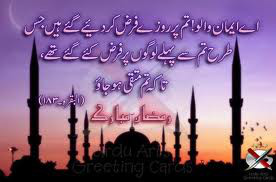
Along with salat, another important form of worship is fasting. It is obligatory for each Muslim, apart from some exemptions, to fast in the month of Ramadhan. During the hours of fasting, food and drink and conjugal relations between husband and wife are forbidden. It is enjoined that during fasting one should pay attention to remembrance of God and study the Holy Quran in abundance. One should try to curtail one's worldly pastimes as much as possible during Ramadhan, and to be particularly inclined towards charity and alms giving.
Human life is dependent on food and drink and the continuation of the human race depends on the marital relationship. While fasting one refrains from them both, as if bearing witness to God that for His pleasure man gives up the factors (temporarily) upon which his very existence depends. The various other benefits of fasting are that man gets to exercise sacrificing physical comfort and to endure hunger and thirst. Fasting creates a sense of equality between the rich and the poor. By developing an appreciation of hunger and thirst, it makes the well-off think of the needs of the poor and impresses a feeling of compassion in their hearts. It makes them appreciate, through the practicality of it, the state a human being endures when hungry and thirsty. Ramadhan is a most effective and excellent means of spiritual development for mankind.
Zakat
Zakat (Alms giving) is a part of devotion enjoined upon Muslims by the Holy Quran. It is a means where the well-off pay a set amount of their wealth. Zakat means to purify oneself. It is obligatory on Muslims to pay a little percentage of their accumulated wealth towards Zakat, which is used for the benefit of the needy and the poor. Zakat is not levied on one's property that is in personal use, rather on the assets which have a means of increasing and which are surplus to one's needs. It is a means of social justice and order. It teaches sympathy of the highest order.
Hajj
Hajj is the fifth Pillar of Islam and another form of worship. It is an annual pilgrimage to the holy sites in Mecca which each adult Muslim, who can afford it, has to perform once in life time. Apart from the financial aspect, the ability to afford the pilgrimage also means that one is able to travel and perform the Hajj in peace.
Muslims perform Hajj in order to visit for themselves the holy sites where their faith started. More importantly it is a pilgrimage to the Ka'aba, which we believe is the first place of worship ever built on this earth, Muslims thus refer to it as House of God. The ceremony of Hajj is also symbolic of the Unity of God; all Muslims gather from four corners of the earth in one spot at an appointed time and worship God. There are no difficulties to perform Hajj apart from the obvious financial commitment in order to travel to Mecca. That is the reason why, strictly speaking, Hajj is only obligatory to those who have fulfilled all their worldly needs and have no pressing commitments left and indeed can afford the passage to Mecca.
It is a Muslim belief that God is everywhere and He answers those who truly seek Him. In this respect indeed going to a particular place to seek the pleasure and nearness to God is not the issue. However, it is the physical presence of being in the holiest of the holy places for the Muslim faith and indeed the congregational worship with millions of other fellow Muslims that leaves an indelible mark on the spiritual life of a person. It is a most supreme form of worship and is most desirable to God.
During Hajj, the person who intends to perform it is required to travel to Mecca during the prescribed days and observe all the rites and ceremonies. During Hajj Muslims from all corners of the world gather in Mecca and perform the rites of Hajj and thus strengthen the bond of Muslim unity.
During Hajj each place brings to mind some event of the blessed life of the Holy Prophet (peace and blessings on him). It refreshes the memory of the supreme sacrifices made by the Holy Prophet (peace and blessings on him) for the sake of Islam.
If you wan't to add something to this page then add a Comment below:

Thanks For Visiting Our Site
Click Here to go back to the Home page
Click here to join our facebook Community
